100 Days of School Embroidery Design: A Practical Guide for Educators and Creators
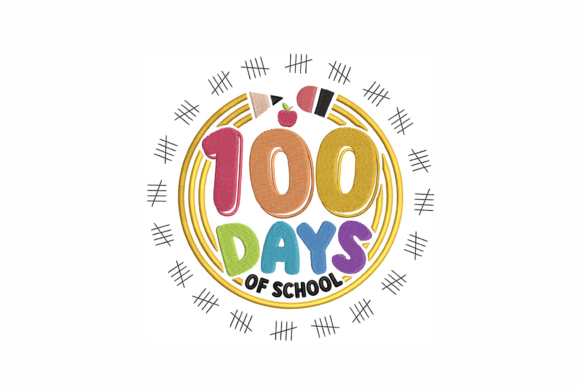
The 100th day of school is a significant milestone in the elementary education calendar, marking a transition from early learning to more advanced concepts. For teachers, parents, and small business owners looking to commemorate this event, the 100 Days of School Embroidery Design offers a versatile solution. This digital asset features bright, playful typography alongside classic educational icons like pencils, apples, and tally marks. Unlike printed graphics, embroidery adds texture and durability, making it a distinct choice for creating lasting memories on clothing and classroom décor.
When evaluating resources for this specific celebration, it is essential to understand what makes an embroidery file unique compared to other formats. The primary distinction lies in the physical application. While a print-on-demand T-shirt relies on ink or vinyl adhering to the surface, an embroidery design stitches thread into the fabric itself. This creates a raised, tactile finish that withstands repeated washing better than many screen-printed alternatives. For educators organizing class parties or crafters selling commemorative items, the 100 Days of School Embroidery Design provides a professional look that elevates simple garments into spirited keepsakes.
Evaluating Format Options: Digital Files vs. Physical Products
A critical decision factor for buyers is understanding the delivery method. The 100 Days of School Embroidery Design is available as a digital download only. This means no physical item will be shipped; instead, the purchaser receives a file compatible with standard embroidery machines. This format offers immediate access and flexibility but requires the user to have the necessary equipment or services to execute the stitching.
For those without an embroidery machine, the tradeoff involves outsourcing the production. Many local print shops or online embroidery services accept digital files for custom runs. In contrast, purchasing pre-embroidered apparel removes the technical barrier but often limits customization options regarding color placement, garment style, and sizing. If you are an elementary teacher planning a one-off class photo, buying pre-made shirts might be simpler. However, if you are running a small business or need a large batch of varied items—such as tote bags, sweatshirts, and T-shirts—the digital file approach is often more cost-effective and adaptable.
Consider the following comparison of approaches:
- Digital Download: Requires an embroidery machine or third-party service; allows infinite customization of colors and placement; best for bulk orders or resale.
- Pre-Made Apparel: Ready to wear immediately; limited selection of styles and colors; higher per-unit cost for small quantities.
- Vinyl Heat Transfer: Easier to apply at home with an iron or heat press; lacks the textured, premium feel of stitched thread; may crack over time.
Design Elements and Visual Impact
The visual composition of the 100 Days of School Embroidery Design is tailored specifically for the target demographic of young students and their families. The inclusion of colorful letters, a pencil, an apple, and tally marks serves a dual purpose: it captures the excitement of the milestone while reinforcing mathematical concepts like counting and grouping. These elements are not merely decorative; they resonate with the curriculum typically covered around the 100-day mark.
When comparing this design to generic "school spirit" patterns, the specificity matters. Generic designs often feature broad themes like books or globes, which are useful year-round but lack the immediacy of the 100-day celebration. The tally marks, in particular, add a layer of educational relevance that appeals to teachers who want the merchandise to double as a learning tool. The bright color palette is another distinguishing feature. In embroidery, vibrant threads stand out against neutral backgrounds like navy blue, black, or white, ensuring the design remains legible and cheerful even after years of wear.
However, there are limitations to consider regarding the complexity of the design. Embroidery has a practical limit on how much detail can be rendered in thread. Extremely fine lines or gradients found in digital illustrations often translate poorly when stitched. The 100 Days of School Embroidery Design avoids this pitfall by utilizing bold shapes and clear outlines. This ensures that the final product looks crisp rather than muddy, a common issue when users attempt to stitch overly complex images intended for printing.
Suitability for Different User Profiles
Understanding who benefits most from this resource helps in making an informed purchase decision. The primary audience includes elementary school teachers, homeschooling parents, and small business entrepreneurs.
For Teachers and Schools
Teachers often seek ways to build community and create a sense of occasion. A uniform look for the class photo is a popular tradition. Using the 100 Days of School Embroidery Design allows a teacher to order matching T-shirts or hats for the entire class. Because the file is digital, the teacher can adjust the size of the design to fit different age groups, from kindergarten to fifth grade, ensuring the proportions look correct on smaller versus larger chests. This adaptability is a significant advantage over fixed-size commercial products.
For Small Business Owners
Crafters and boutique owners can leverage this design to create niche products for the back-to-school season. By applying the design to tote bags, backpacks, or sweatshirts, sellers can offer unique items that mass-market retailers do not carry. The key here is volume and variety. Since the file is a one-time purchase, the marginal cost of producing each additional item drops significantly. This makes it a viable option for scaling up during peak demand periods in January and February, when schools typically celebrate the milestone.
For DIY Enthusiasts
Parents with home embroidery machines can use this file to personalize gifts for their children. The ability to customize the color scheme to match a child's favorite team or personal preference adds a sentimental value that store-bought items cannot replicate. However, this path requires a moderate level of technical skill. Users must ensure their stabilizer and hoop settings are appropriate for the fabric type to prevent puckering or shifting during the stitching process.
Tradeoffs and Decision Factors
While the 100 Days of School Embroidery Design offers many advantages, it is not the right choice for every situation. Time is a major constraint. If the 100-day celebration is approaching within a week, sourcing materials, digitizing (if needed), and stitching the items may be too slow. In such cases, ordering pre-printed items or using iron-on transfers might be the only feasible alternative.
Budget is another consideration. While the digital file itself is affordable, the overhead costs of thread, stabilizers, and electricity can add up for large projects. Furthermore, if the user does not own an embroidery machine, the cost of hiring a professional service to stitch the designs may exceed the price of buying ready-made apparel. It is crucial to calculate the total cost per unit before committing to a large production run.
Another factor is the intended lifespan of the item. Embroidery is durable, but it is also permanent. Once stitched, the design cannot be easily removed or altered. If there is a risk of the student outgrowing the shirt quickly or if the design might become outdated, a removable patch or a temporary transfer could be a safer investment. Conversely, for items meant to be kept as heirlooms or worn for several years, the permanence of embroidery is a distinct benefit.
Practical Application and Best Practices
To maximize the value of the 100 Days of School Embroidery Design, proper execution is key. When applying the design to different substrates, the technique varies. On T-shirts, a medium-weight knit stabilizer is usually sufficient. For heavier items like sweatshirts, a tear-away or cut-away stabilizer provides the necessary support to prevent distortion. Tote bags, being made of woven canvas, require a different approach, often needing a water-soluble topping to keep the thread from sinking into the weave.
Color matching is also vital for the "bright and playful" aesthetic promised by the design. Thread manufacturers use standardized color codes, so it is advisable to review the thread chart before purchasing supplies to ensure the final result matches the preview image. Mismatched threads can dull the impact of the colorful letters and icons, detracting from the celebratory nature of the project.
Ultimately, the decision to use an embroidery design depends on the balance between effort, cost, and desired quality. For those willing to invest the time and resources, the 100 Days of School Embroidery Design delivers a premium, durable, and highly customizable product. It stands out against the sea of disposable party favors and mass-produced clothing, offering a tangible way to honor a major educational achievement. Whether used for a single family keepsake or a full classroom wardrobe, the design serves as a functional and festive tool for marking the journey of learning.